Here's a collection of TLS videos from partners and collaborators
ABC video TLSIIG work in 2013
Forest Research a Year in the Life of an Oak tree for the BBC
Tampere University of Technology 3D forest information
SALCA overview of SALCA in action in Australia and UK
Wednesday, 25 March 2015

Friday, 16 January 2015
Leaf area profile data for Alice Holt
The first results of the leaf area profiles derived for the destructively sampled trees at Alice Holt in 2014 are now available. These results will be published in full in due course but are provided here for collaborators and others interested in the work. Thanks to Dr Eric Casella of Forest Research for coordinating the work and for the 'volunteers' from UCL, Salford University and Forest Research for picking the leaves!

For more information contact Dr Eric Casella,
Forest Research, Alice Holt Lodge, Farnham,Surrey GU10 4LH, UK
 |
| Leaf area profile for Large Oak - total LAI 4.17 (SALCA scan to the left) |
For more information contact Dr Eric Casella,
Forest Research, Alice Holt Lodge, Farnham,Surrey GU10 4LH, UK
Tuesday, 25 November 2014
SALCA at the Manchester Science Festival
Mark Danson gave a series of public demonstrations of SALCA at the Salford Sci-Fest in October - part of the 2014 Manchester Science Festival. More than 2000 people attended the event held at the University's Media City Campus on Salford Quays. The demonstration included experiments to measure the speed of light, videos of SALCA in action, and a live demonstration of the instrument.
 |
| Lasers Light up the Forest |
Thursday, 13 November 2014
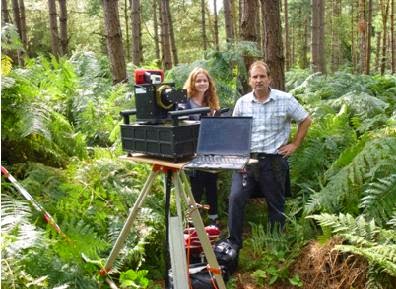
Sheffield A-level Geography student working at Delamere
This summer saw Phoebe Cox helping out with
fieldwork at Delamere Forest. Phoebe, an A-level Geography student from Sheffield, completed a stand survey with Lucy,
measuring tree diameters (dbh) and tree heights at the Beech plot. These data
will be used to verify the canopy measurements made from the SALCA instrument
providing validation of the height, height to base of live crown and dbh
estimates. She also had an introduction to the SALCA instrument and battled
through the undergrowth to see how the instrument worked in the pine plot.

The maximum tree height was around 33m
Wednesday, 10 September 2014
Keynote for Mark Danson
Mark Danson presented an Invited Keynote Talk at the Annual Conference of the Remote Sensing and Photogrammetry Society http://rspsoc2014.co.uk/, hosted by the University of Aberystwyth and Environment Systems, last week. Lucy Walker also presented a paper on SALCA measurement of 4D forest phenology. Both papers were well received and there were around 150 registered delegates. The Abstract of Mark's talk is reproduced below.
.jpg) |
| Mark Danson delivering Keynote at RSPSoc 2014 |
Laser spotlight on forest structure
Terrestrial laser
scanners (TLS) are set to revolutionise measurement of the three-dimensional
structure of vegetation canopies, completely replacing manual measurements or
indirect estimates of canopy structure, based on light interception. TLS record
millions of range measurements of the canopy and understorey elements, in a
rapid and repeatable way, and this information can be used to estimate, amongst
other things, tree biomass and canopy leaf area index (LAI), and to accurately
reconstruct the complete three-dimensional structure of forest stands. Early
attempts to extract quantitative information on vegetation from commercial TLS data
soon encountered problems related to difficulty in using the radiometric
information contained in the data. In response my team at the University of
Salford worked with Halo Photonics Ltd. to develop and test the experimental
Salford Advanced Laser Canopy Analyser, or SALCA for short, the world’s first
dual-wavelength, full-waveform terrestrial laser scanner specifically designed
for measuring forest canopy structure. SALCA provides a test-bed for better understanding
the interaction of lasers with vegetation canopies, and an open-access mode of
working allows research partners and collaborators to fully explore the
strengths and weaknesses of different data processing and information
extraction algorithms. In the presentation I will outline the origins of the
SALCA instrument, talk about the trials and tribulations of instrument
development, discuss examples of the applications which are now being explored and,
by example, highlight the importance and benefits of collaborative working in
science.
Friday, 15 August 2014
Developing a dual-wavelength full-waveform terrestrial laser scanner to characterize forest canopy structure
New publication on SALCA in Agricultural and Forest Meteorology - Open Access - click below to read
Developing a dual-wavelength full-waveform terrestrial laser scanner to characterize forest canopy structure
Developing a dual-wavelength full-waveform terrestrial laser scanner to characterize forest canopy structure
Friday, 8 August 2014
Destructive sampling of oak LAI at Alice Holt
A team from the Universities of Salford, UCL and Newcastle and Forest Research UK completed the destructive sampling of three 80 year old oak trees at Alice Holt in Surrey.
Following leaf off scanning in March and leaf-on scanning in June the three oaks were felled and all leaves removed by the team and bagged to determine their dry weight. We will estimate tree LAI through measurements of specific leaf area (SLA) on a sample of 800 leaves. More results to follow...but here's a short video to illustrate the approach...on YouTube
Following leaf off scanning in March and leaf-on scanning in June the three oaks were felled and all leaves removed by the team and bagged to determine their dry weight. We will estimate tree LAI through measurements of specific leaf area (SLA) on a sample of 800 leaves. More results to follow...but here's a short video to illustrate the approach...on YouTube
Subscribe to:
Posts (Atom)