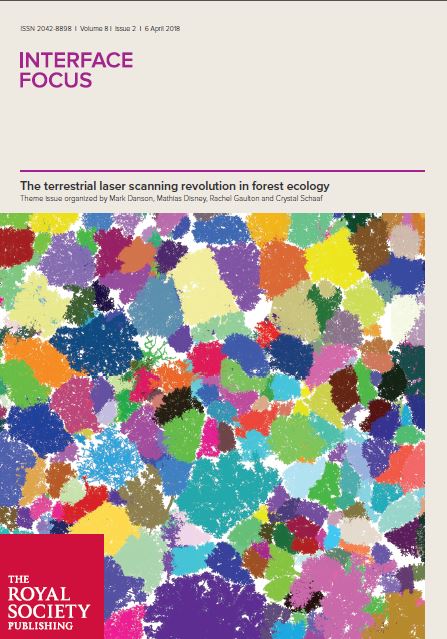
Our special issue of Interface Focus from the The Royal Society is now published! The issue "The terrestrial laser scanning revolution in forest ecology" features 11 papers from some of the world's leading experts on TLS. Read The Royal Society Blog here:
https://blogs.royalsociety.org/publishing/laser-scanning-revolution/
The contents page is here:
http://rsfs.royalsocietypublishing.org/content/8/2
Mark, Lucy and Fadal have published the latest SALCA paper in the issue and it can be downloaded here:
https://www.researchgate.net/profile/Francis_Danson
Vegetation structure is important for measuring forest growth and the carbon cycle. Developed by the University of Salford and Halo Photonics Ltd, the Salford Advanced Laser Canopy Analyser (SALCA) is a unique multi-spectral, full waveform laser scanner using two wavelengths allowing distinction between leaves and woody material. This blog follows our research funded by the UK NERC and involving University of Newcastle, University College London and UK Forest Research.
Monday, 19 February 2018
Monday, 3 July 2017
Mark's Presentation at Royal Society meeting
Here is a video of Mark Danson's presentation of the Royal Society meeting held in February this year. Sound recordings of all the presentations are available at:
https://royalsociety.org/science-events-and-lectures/2017/02/forest-ecology/
https://www.youtube.com/watch?v=apkIN-U5jhE
https://royalsociety.org/science-events-and-lectures/2017/02/forest-ecology/
https://www.youtube.com/watch?v=apkIN-U5jhE
Friday, 10 March 2017
Royal approval for TLS research!
Last week
saw 70 researchers from around the world attend a two-day meeting at the Royal
Society’s country venue, Chicheley Hall, in Northamptonshire, to discuss “The
Terrestrial Laser Scanning Revolution in Forest Ecology”. The meeting,
organised by Mark Danson, was a Theo Murphy Scientific Meeting funded by The Royal Society and
featured a star line-up of keynote presentations by researchers from around
the world, with associated discussion and poster sessions. The speakers were
drawn from the UK, US, Germany, Finland, Australia, China and Switzerland with
other participants representing a further five countries.
Terrestrial
laser scanners, or TLS for short, provide detailed three-dimensional
measurements of forests, by firing millions of laser pulses up into the
canopy. The information recorded can
then be used to monitor changes in forest structure and biomass with
unprecedented accuracy. These measurements are set to revolutionize the way in
which ecologists measure forests, and will help determine whether forests are
acting as carbon sinks, absorbing excess carbon dioxide in the atmosphere, or
carbon sources, adding to the greenhouse effect.
The meeting
discussed the technology, applications and challenges of using TLS in forest
ecology and showed how it is essential to improve the accuracy of measurements
of the biomass of forests so as to better quantify the storage of carbon in
such ecosystems. TLS devices can do this by ‘weighing trees with lasers’ based
on three-dimensional reconstructions of complete forests. The dynamic nature of
forest growth was another important theme with Professor Danson describing how
a new TLS device, the Salford Advanced Laser Canopy Analyser, or SALCA for
short, can be used to map the growth and fall of leaves in UK woodlands.
Outputs from the meeting will include a special issue of the Royal Society’s
in-house journal Interface Focus which will be edited by Professor Danson and
his colleagues from the Universities of Newcastle, University College LondonWednesday, 7 December 2016
New video on SALCA research
This is an extract from the new University of Salford, Ecosystems and Environment Research Centre (EERC) video highlighting areas of research excellence. This extract features an interview with Mark Danson and Fadal Sasse in Peel Park on the University of Salford campus.
https://www.youtube.com/watch?v=oyTUGi6fTE4
The full video can be viewed here:
Wednesday, 31 August 2016
The terrestrial laser scanning revolution in forest ecology
The full programme of 16 invited speakers for our Royal Society Theo Murphy Scientific meeting in February 2017 is now available at: https://royalsociety.org/science-events-and-lectures/2017/02/forest-ecology/
We have around 50 participants to date and there are still places available. If you would like to attend (there is no registration fee) press the 'Request an invitation' button from the link above.
Poster contributions are welcomed and again follow the guidelines on the Royal Society's web page
We have around 50 participants to date and there are still places available. If you would like to attend (there is no registration fee) press the 'Request an invitation' button from the link above.
Poster contributions are welcomed and again follow the guidelines on the Royal Society's web page
Monday, 21 March 2016
PhD for Lucy Schofield
Congratulations to Lucy Schofield who successfully defended her PhD last week. Lucy's thesis is the first study to examine the application of dual-wavelength full-waveform data from the Salford Advanced Laser Canopy Analyser (SALCA) for measuring the phenology of woodland canopies. The thesis was entitled "Quantifying structural change in UK woodland canopies with a dual-wavelength full-waveform Terrestrial Laser Scanner". The thesis will be available as a pdf in a few weeks time. For further details contact Lucy at l.a.schofield@edu.salford.ac.uk
| Lucy and SALCA at Delamere Forest, UK |
TLSIIG researchers to lead Royal Society international research meeting
Professor
Mark Danson, Dr Mat Disney, Dr Rachel Gaulton, and Professor Crystal Schaaf,
all members of the Terrestrial Laser Scanner International Interest Group
(TLSIIG) have won support from the Royal Society to lead a Theo Murphy
International Scientific Meeting to be held at The Society’s Chicheley Hall in the
UK in February 2017. The meeting will bring together a star line-up of
researchers from around the world to discuss “The terrestrial laser scanning
revolution in forest ecology”. The meeting organizers are from the University
of Salford, UK, University College London, UK, University of Newcastle, UK and University
of Massachusetts Boston, US, and are among the sixteen invited speakers from
Australia, United States, Finland, Netherlands and the UK.
Terrestrial
laser scanners, or TLS for short, provide detailed three-dimensional
measurements of forests, by firing millions of laser pulses up into the canopy. The information recorded can then be used to
monitor changes in forest structure and biomass with unprecedented accuracy. These
measurements are set to revolutionize the way in which ecologists measure
forests, and will help determine whether forests are acting as carbon sinks,
absorbing excess carbon dioxide in the atmosphere, or carbon sources, adding to
the greenhouse effect.
| SALCA range image at Alice Holt, Hampshire |
The meeting
will lead to a Special Themed issue of the Royal Society’s inter-disciplinary
journal Interface Focus, with Professor Danson as lead editor. Professor Danson
said: “This support from the UK’s most eminent scientific society will be a showcase
Salford’s world-leading research in TLS applications in ecology. It will also provide
a forum for developing this research field, along with other key players from
around the world”. The meeting will take place 27-28th February 2017 and the Programme will be released shortly.
Subscribe to:
Posts (Atom)

