Sunday, 30 June 2013

SALCA down on the farm


June saw SALCA return to Newcastle for NERC-funded field experiments testing the sensitivity of the instrument to changes in canopy moisture content. The (literal) field experiment, involving 22 potted trees at the University’s Cockle Park Farm, involves repeated SALCA scans as drought stress is induced in groups of trees over a period of 1 month, alongside scans of regularly watered controls. The SALCA signal will be compared to a range of physiological measurements and to spectral data acquired with an ASD field spectrometer. The experiment is now well under way, and after initial teething problems with windthrow and over inquisitive and hungry livestock, the drying groups of small-leaved lime (Tilia cordata) and Austrian pine have been gradually wilting for a little over a week. Steve has got to grips with the operation of a cherry picker and fingers are crossed that the so far almost ideal weather will last! Early results from the experiments will be presented in a poster at INTECOL, London in August. 

 
Setting up the experiments
  
What happens when sheep get hold of a windblown experimental tree, and a possible culprit.


Clockwise: SALCA in the field, a small-leaved lime drying group with intensity calibration board, measuring stomatal conductance and contact probe measurments of leaf reflectance properties.
 

Thursday, 18 April 2013

First Prize for Lucy

New team member Lucy Walker presented her research ideas at the recent "Wavelength" conference of the Remote Sensing and Photogrammetry Society, at Glasgow University 11-13 March 2013. She presented a poster describing the SALCA instrument, its measurement capabilities and characteristics, and some of her initial experimental results. The conference was attended by around fifty participants and included both key-note speakers and poster sessions. 

Lucy's poster was very well received and she was awarded a prize for the best poster at the conference. Congratulations Lucy!


Wednesday, 20 March 2013

SALCA @ Newcastle


2013 kicked off with another new addition to the SALCA team. Steve Hancock (previously at Swansea University) started work as a Postdoctoral Research Associate at Newcastle University as the latest NERC grant got under way  The project is examining the potential of dual-wavelength laser scanning for monitoring leaf moisture content at canopy scales through both laboratory and small-scale field experiments at one of the Newcastle University farms.  The initial project meeting, including project partners from Salford (Mark Danson, Lucy Walker) and UCL (Mat Disney, Andrew Burt), was held in January, providing a useful opportunity to catch up on progress, introduce new members of the team and make future plans. Since then Steve has been busy planning experiments and these are now under way  with SALCA on loan from Salford University for the next month. Priorities include examining leaf-level responses from a variety of species (including conifers) and undertaking laboratory-based scans of small trees.  Other efforts (at Newcastle and Salford) are focussed on code and model development to improve data analysis and understanding of the SALCA signal. Expect more soon from Steve as he starts to produce some preliminary results!

Steve, with SALCA, at Newcastle University

Tuesday, 5 February 2013

SALCA paper in Remote Sensing of Environment


We are pleased to say that the results of the leaf drying experiments described earlier in the blog, and some additional modelling work, have now been published online in Remote Sensing of Environment. The paper demonstrates a good relationship between a normalised ratio of the two SALCA wavelengths and leaf equivalent thickness and shows the values of this ratio to be in-line with those expected based on PROSPECT leaf optical properties modelling. It represents the first test of an active laser scanning instrument for measuring leaf moisture content. The challenge now of course is to scale this up to canopy levels - lots more to come on that over the next few months!

You can read more in the final article available online:
Gaulton, R., Danson, F.M., Ramirez, F.A. and Gunawan, O. (2013). The potential of dual-wavelength laser scanning for estimating vegetation moisture content. Remote Sensing of Environment, 132, 32-39.

Monday, 1 October 2012

New SALCA team member


The end of September saw an new addition to the SALCA team in the shape of a NERC-funded PhD student, Lucy Walker. With a background in geography, GIS, and ecology, Lucy will be investigating the use and application of SALCA for the study of forest carbon dynamics over the next 3 years, under the supervision of Mark Danson and Neil Entwistle at the University of Salford. Since starting in Salford, Lucy has been working on a range of preliminary experiments, as well as getting to grips with the data processing side of things! One of the ongoing experiments, investigating the signal measured by SALCA as trees dry out, began in December - with a festive edge!

Festive laser scanning
 

SALCA team goes to Silvilaser


September brought a trip to North America for the SALCA team. Rachel attended the ForestSAT 2012 conference in Corvallis, Oregon and the whole team was present at Silvilaser 2012 in Vancouver with a presentation providing an overview of the SALCA work and a more focussed poster on leaf moisture measurements. 
Silvilaser also brought the opportunity to learn more about SALCA’s American cousin, DWEL. The DWEL system, being developed by Alan Strahler at Boston University, shares some of the characteristics of SALCA, including dual near- and short -wave infrared lasers, but also has some important differences, opening the door for some interesting comparisons in the future. Silvilaser also brought the inaugural meeting of TLSIIG, the Terrestrial Laser Scanning International Interest Group, organised by Alan. The meeting raised some great possibilities for future activities, including instrument intercomparisons and data sharing. 

To top off a great trip, Mark and Rachel also found time for some rock climbing just up the road in Squamish.


Saturday, 1 September 2012

Further SALCA Diaries Update


June 2012
Some great news for the SALCA project came in late June, in the form of a further successful NERC grant to examine the potential for monitoring vegetation moisture content at canopy scales. The New Investigator Grant to Newcastle University (PI: Rachel Gaulton), with Mark Danson and Mat Disney (UCL) as project partners, will fund a range of laboratory and field experiments to examine SALCA response to drought stressed tree canopies and to examine the potential for use of SALCA data and models, developed by UCL, to upscale leaf physiological measurements to the canopy scales of relevance to satellite measurements.  The project will kick-off in January 2013.

August 2012
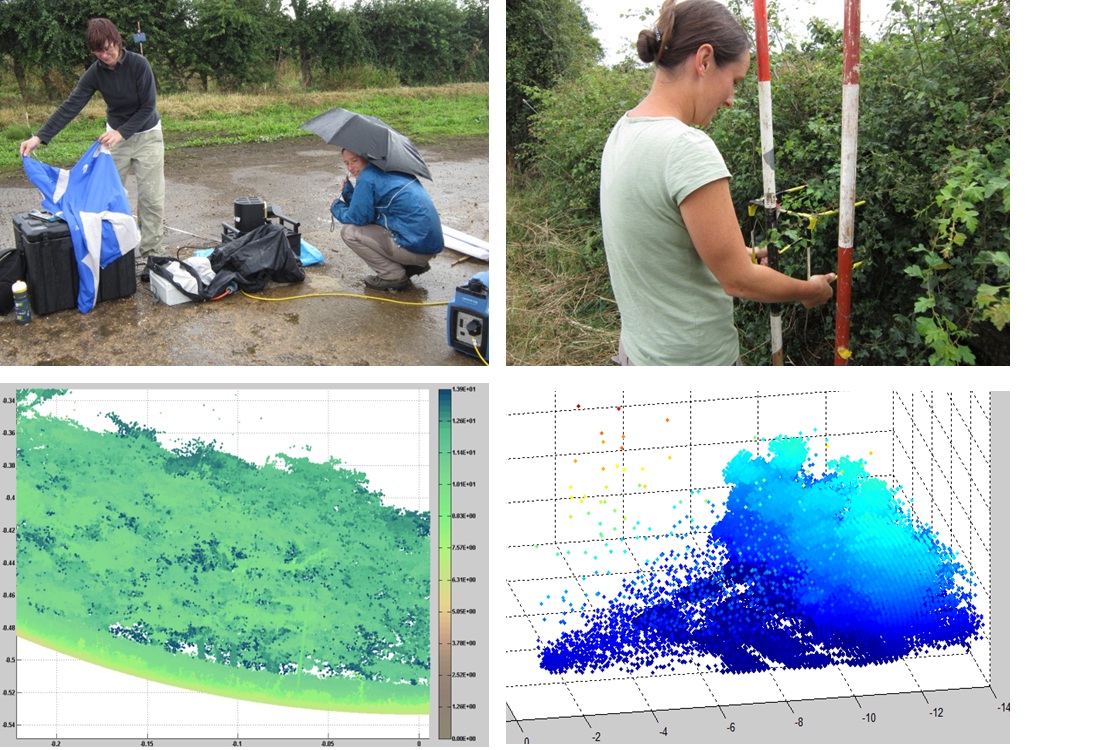
To make the most of the beautiful British summer, we took SALCA back out in the field to test out a potential application for full-waveform TLS in hedgerow condition monitoring. This work, with France Gerard, Jo Staley and Sam Amy from the UK's Centre for Ecology and Hydrology (CEH) arose from conversations in the back of a taxi after the FERA workshop and is intended to test TLS for deriving structural characteristics of hedgerows, an important habitat feature in the British countryside.  Needless to say the British weather rather let us down, with strong winds giving way later in the day to sudden showers. With careful use of an umbrella we managed to get some SALCA data and make some interesting field measurements of hedge density and LAI, and work is on-going to investigate the structural properties that could be extracted.

France Gerard and Sam Amy at the CEH testsite in Oxfordshire - with initial data visualisations of one of test hedges - and yes SALCA more or less waterproof!