Friday, 4 November 2011
Range and reflectance calibration measurement
We have been testing the range dependence of the SALCA returns in a series of indoor experiments. The objective is to derive an empirical range corrections that can be applied to the waveforms in order to move forward with quantitative analysis of the intensity information. Alberto has derived a field based method for the Riegl scanners and we will compare this approach with the results from the lab calibration.

Monday, 17 October 2011
SALCA back in business
October has seen some changes for the SALCA project with Oliver Gunawan moving from the SALCA research assistant position to take up a PhD in the School. Oliver will be working on spatial mapping of urban areas and will incorporate airborne and maybe terretrial laser scanning into the project.
October also saw Alberto Ramirez complete his PhD research using our Riegl TLS system to characterize multi-temporal changes in forest stands at Delamere Forest. Alberto has now taken over from Oliver and is starting to run a series of new calibration tests following the return of SALCA from Halo Photonics. Some adjustments have been made to the power of the lasers in order to better balance the return intensities from the two wavelengths. A new filter mount has allowed us to dispense with the cardboard and sticky tape, and the pulse repetition has been modified in 'stare' mode.
 |
| Dr Alberto Ramirez finally gets his hands on SALCA |
Monday, 19 September 2011
SALCA goes to Halo and we go to Bournemouth!
SALCA was finally delivered back to Halo Photonics, 2 hours down the M6 to Worcester. A useful discussion with Guy Pearson ironed out the amends that need to be completed on SALCA, which include:
1) Repositioning of the laser beams or over-rotation of SALCA to eliminate a blind spot that we have discovered.
2) Tweaking of beam magnitude in order to use only 1 ND filter. This will remove the need to perform consequent scans for each wavelength and will therefore greatly increase the quality of our data collection.
3) Installation of a more powerful digitiser that we are hoping will help toward speed SALCA up, either by continuous rotation of the head (without pause for download), or by the increased memory capacity, which would enable one single download at the end of a scan.
4) Investigation into SALCA beam power loss over time.
5) A more permanent mount designed to the amended filter angle, which should allow us to use and change filters on SALCA more easily.
Meanwhile, myself, Mark and Rachel attended the Remote Sensing and Photogrammetry Society Conference 2011 last week in Bournemouth, where Mark and Rachel were both well received in presenting the progress we have made, both practically and scientifically with the SALCA project, paying particular attention to the fieldwork completed and also the progress made with our moisture loss experiments.
Provisionally, we are hoping to retrieve SALCA in early October, which means we will have time to run more calibration tests before taking the scanner back to Delamere to try to catch the leaf off process, which should provide us with more useful phenological data.
Oliver Gunawan
19th September 2011
1) Repositioning of the laser beams or over-rotation of SALCA to eliminate a blind spot that we have discovered.
2) Tweaking of beam magnitude in order to use only 1 ND filter. This will remove the need to perform consequent scans for each wavelength and will therefore greatly increase the quality of our data collection.
3) Installation of a more powerful digitiser that we are hoping will help toward speed SALCA up, either by continuous rotation of the head (without pause for download), or by the increased memory capacity, which would enable one single download at the end of a scan.
4) Investigation into SALCA beam power loss over time.
5) A more permanent mount designed to the amended filter angle, which should allow us to use and change filters on SALCA more easily.
Meanwhile, myself, Mark and Rachel attended the Remote Sensing and Photogrammetry Society Conference 2011 last week in Bournemouth, where Mark and Rachel were both well received in presenting the progress we have made, both practically and scientifically with the SALCA project, paying particular attention to the fieldwork completed and also the progress made with our moisture loss experiments.
Provisionally, we are hoping to retrieve SALCA in early October, which means we will have time to run more calibration tests before taking the scanner back to Delamere to try to catch the leaf off process, which should provide us with more useful phenological data.
Oliver Gunawan
19th September 2011
Friday, 12 August 2011
Leaf Drying and Range Calibration
Before SALCA is taken back to Halo Photonics, we need to complete a couple of experiments in order to make better use of the data sets we have already collected and to see if future plans are viable. Consequently,I have completed a leaf drying test and also a close-range calibration experiment.
The leaf experiment was carried out using a fresh, whole leaf, which was fitted into a pre-weighed mount and placed next to 2 panels of known reflectances. The three targets were then scanned repeatedly over the course of 3 days with the mounted leaf being weighed after each scan. The purpose of this experiment is to see if the ratio of the two wavelengths changes during the drying process (as theory indicates), which would then be a useful indicator of moisture levels within canopies.
The close-range experiment is important because we have found a fluctuation in intensities at ranges of 0.25 m - 7 m. This experiment was conducted using 2 panels of known reflectance. One panel was kept static and another was placed at different distances from SALCA before being scanned. 16 scan positions were measured up to 7m, which should provide useful information for characterising the fluctuation in order to correct any values within this range.
Oliver Gunawan
12th August 2011
 |
| Leaf used in experiment |
 |
| Sand paper, Spectralon panel and mounted leaf |
The leaf experiment was carried out using a fresh, whole leaf, which was fitted into a pre-weighed mount and placed next to 2 panels of known reflectances. The three targets were then scanned repeatedly over the course of 3 days with the mounted leaf being weighed after each scan. The purpose of this experiment is to see if the ratio of the two wavelengths changes during the drying process (as theory indicates), which would then be a useful indicator of moisture levels within canopies.
 |
| Leaf drying experiment |
The close-range experiment is important because we have found a fluctuation in intensities at ranges of 0.25 m - 7 m. This experiment was conducted using 2 panels of known reflectance. One panel was kept static and another was placed at different distances from SALCA before being scanned. 16 scan positions were measured up to 7m, which should provide useful information for characterising the fluctuation in order to correct any values within this range.
 |
| Range Calibration: Left hand panel is stationary. Right hand panel moves in between scans. |
Oliver Gunawan
12th August 2011
Monday, 25 July 2011
Taking the Riegl 390 out
I am accompanied today by Alberto Ramirez to complete scans of some of the plots we visited at the beginning of July using the Riegl Z390 laser scanner. This is a commercial scanner, which has been used extensively by Alberto during his PhD research.
As a commercial unit, the Riegl is much quicker and simpler to set up, however we can only extract the first returns from the collected datasets. We are aiming to gather comparative gap fraction data to use against SALCA and the hemispherical photography. 2 ND0.6 filters were attached side by side to the receiving lens of the scanner as previous research has found the intensities saturate, making further analysis difficult. Using a resolution of 0.1 degrees in both the elevation and azimuth, we complete 2 6 minute scans at each plot (the second scan being positioned perpendicular to the first to collect the full hemisphere).
Building on Alberto's work, we have managed a full 'point-based' approach to gap fraction analysis, where the beam either hits a target 100% or not at all. This produces an underestimation of the gap fraction (the gap appears smaller) because sometimes only part of the beam is interrupted. By weighting by intensity and using only the first return, we are now overestimating the gap fraction, as we are not considering the interception of further returns. The next step is to focus on the effects of additional returns in sequence.
We manage a full day of research, scanning an unprecedented 8 sites across delamere, which should supply a good range of canopy compositions and densities:
Plot 1: Corsican Pine
Plot 2: Oak / Sweet Chestnut / Silver Birch
Plot 3: Sweet Chestnut
Plot 4: Corsican Pine
Plot 5: Larch
Plot 10: Open Corsican Pine
Plot 11: Dense Corsican Pine
Plot 14: Dense mixed Deciduous
Oliver Gunawan
25th July 2011
 |
| The Riegl Z390 at plot 2 |
As a commercial unit, the Riegl is much quicker and simpler to set up, however we can only extract the first returns from the collected datasets. We are aiming to gather comparative gap fraction data to use against SALCA and the hemispherical photography. 2 ND0.6 filters were attached side by side to the receiving lens of the scanner as previous research has found the intensities saturate, making further analysis difficult. Using a resolution of 0.1 degrees in both the elevation and azimuth, we complete 2 6 minute scans at each plot (the second scan being positioned perpendicular to the first to collect the full hemisphere).
 |
| Alberto with the Riegl at plot 3 |
Building on Alberto's work, we have managed a full 'point-based' approach to gap fraction analysis, where the beam either hits a target 100% or not at all. This produces an underestimation of the gap fraction (the gap appears smaller) because sometimes only part of the beam is interrupted. By weighting by intensity and using only the first return, we are now overestimating the gap fraction, as we are not considering the interception of further returns. The next step is to focus on the effects of additional returns in sequence.
 |
| Robo-baby being transported to plot 1 |
We manage a full day of research, scanning an unprecedented 8 sites across delamere, which should supply a good range of canopy compositions and densities:
Plot 1: Corsican Pine
Plot 2: Oak / Sweet Chestnut / Silver Birch
Plot 3: Sweet Chestnut
Plot 4: Corsican Pine
Plot 5: Larch
Plot 10: Open Corsican Pine
Plot 11: Dense Corsican Pine
Plot 14: Dense mixed Deciduous
Oliver Gunawan
25th July 2011
Friday, 8 July 2011
SALCA Field Trip. Final Day
Thursday 7th July was the last full day of experiments planned in Delamere. In order to get our SALCA scan list up to date, we opted for 1 more Coniferous stand and a larch stand. Alberto and Vishal joined us once again to help conduct field measurements.
As well as the manual field measurements mentioned in previous posts, we also take an opportunity to collect GPS positions of each plot using new Trimble devices acquired by the University of Salford.
The picture below shows an example of a tree infected with Red Band Needle Blight. We were informed by the Forestry Commission that this disease mainly affects Corsican Pines, although the cause is not yet known. For this reason, our final plot was by a cross roads between two pine stands, one of which was more affected by the blight. We are hoping that differences in spectral properties may be picked up in SALCA, which could be useful in monitoring change over time of the disease in particularly badly affected areas.
The final day completed, we celebrated with a fantastic Chinese meal in Hatchmere, not 5 minutes drive from the forest car park. Friday morning was all about getting packed up before taking one last hemispherical photo from plot 1 to complete the set. We have collected almost 50Gb of data and over 100 photographs covering 12 plots:
Plot 1: Coniferous (mainly scotts pine)
Plot 2: Mixed deciduous (sessile oak/sweet chestnut/birch)
Plot 3: Deciduous (sweet chestnut)
Plot 4: Coniferous (scotts pine/corsican pine)
Plot 5: Larch
Plot 10: Open coniferous (scotts pine)
Plot 11: Dense coniferous (corsican pine)
Plot 12: Mixed deciduous (perdunculate oak/sweet chestnut/birch)
Plot 13: Open deciduous (sweet chestnut picnic area)
Plot 14: Dense deciduous (mixture of 6 species)
Plot 15: Open deciduous (Beech)
Plot 16: Between 2 coniferous stands
Let the data processing commence!
Oliver Gunawan
8th July 2011
 |
| Plot 5: Larch stand |
As well as the manual field measurements mentioned in previous posts, we also take an opportunity to collect GPS positions of each plot using new Trimble devices acquired by the University of Salford.
 | |
| Alberto and Vishal conducting field measurements at plot 11 |
The picture below shows an example of a tree infected with Red Band Needle Blight. We were informed by the Forestry Commission that this disease mainly affects Corsican Pines, although the cause is not yet known. For this reason, our final plot was by a cross roads between two pine stands, one of which was more affected by the blight. We are hoping that differences in spectral properties may be picked up in SALCA, which could be useful in monitoring change over time of the disease in particularly badly affected areas.
 |
| Red Pine Needle Blight mainly affecting Corsican Pine |
 |
| Alberto, Vishal, Oliver and Richard by plot 16 |
The final day completed, we celebrated with a fantastic Chinese meal in Hatchmere, not 5 minutes drive from the forest car park. Friday morning was all about getting packed up before taking one last hemispherical photo from plot 1 to complete the set. We have collected almost 50Gb of data and over 100 photographs covering 12 plots:
Plot 1: Coniferous (mainly scotts pine)
Plot 2: Mixed deciduous (sessile oak/sweet chestnut/birch)
Plot 3: Deciduous (sweet chestnut)
Plot 4: Coniferous (scotts pine/corsican pine)
Plot 5: Larch
Plot 10: Open coniferous (scotts pine)
Plot 11: Dense coniferous (corsican pine)
Plot 12: Mixed deciduous (perdunculate oak/sweet chestnut/birch)
Plot 13: Open deciduous (sweet chestnut picnic area)
Plot 14: Dense deciduous (mixture of 6 species)
Plot 15: Open deciduous (Beech)
Plot 16: Between 2 coniferous stands
Let the data processing commence!
Oliver Gunawan
8th July 2011
Wednesday, 6 July 2011
SALCA Field Trip day 3
We are joined today by Richard Armitage, Alberto Ramirez, Vishal Bandagula and Turkia Almoustafa from the University of Salford, who have been involved in previous laser scanning research at Delamere forest. Despite some seriously pessimistic weather forecasts on the breakfast news, the day ends up being quite nice and with only a couple of showers interrupting play, we have managed to get a lot done today.
In the morning, we completed an experiment that Richard Casey has put forward, which involves placing a sheet of material with a known reflectance a distance behind leafy and woody material at plot 12, a mixed deciduous plot. This area was then scanned at high resolution using both wavelengths. When the results have been processed, we will be able to isolate intensities that have come from 100% leaf hits and 100% wood hits. Under the assumption that the reflectance of leafy and woody material does not vary, the intensities collected could give us information on what material the beam has hit and by introducing a linear scale, intensity values can show us the proportion of the beam that the target has covered, which will potentially increase the precision of our gap fraction analysis results.
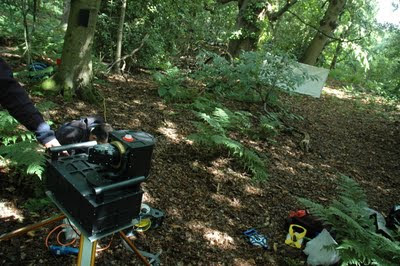
One of our hopes was to use a Reigl 210 scanner to compare our SALCA scan results at each of the plots. However, there has been a technical issue with the Reigl and despite our best efforts, we have not been able to overcome these in the field. We do aim to take the 210 out at some point in the near future, as the data we will collect will be useful in linking this work with previous research conducted by Alberto and Vishal.
In addition to further manual field measurements completed in plot 4, our second scan is completed in an open beech plot (plot 15). This stand has large, old trees and is ideal for a range calibration experiment. As we have not tested how laser intensity changes with range, we place calibration cards with a known reflectance on 8 trees at increasing distances from SALCA. We will be able to compare the results from the intensities of these cards against a theoretical loss of power (1/range squared).

During setup at plot 15, there is a chance encounter with several members of the Forestry Commission. This proves to be a great opportunity for an impromptu demonstration of SALCA and the chance to explain how our research fits into future forest monitoring and management strategies. We also use this as a chance to highlight the benefits of an off-road pram for intensive forestry fieldwork.
Oliver Gunawan
6th July 2011
In the morning, we completed an experiment that Richard Casey has put forward, which involves placing a sheet of material with a known reflectance a distance behind leafy and woody material at plot 12, a mixed deciduous plot. This area was then scanned at high resolution using both wavelengths. When the results have been processed, we will be able to isolate intensities that have come from 100% leaf hits and 100% wood hits. Under the assumption that the reflectance of leafy and woody material does not vary, the intensities collected could give us information on what material the beam has hit and by introducing a linear scale, intensity values can show us the proportion of the beam that the target has covered, which will potentially increase the precision of our gap fraction analysis results.

 |
| Blanket experiment at plot 12 |
One of our hopes was to use a Reigl 210 scanner to compare our SALCA scan results at each of the plots. However, there has been a technical issue with the Reigl and despite our best efforts, we have not been able to overcome these in the field. We do aim to take the 210 out at some point in the near future, as the data we will collect will be useful in linking this work with previous research conducted by Alberto and Vishal.
 |
| Mark and Turkia collecting spectral refectances of leafy and woody material using the ASD |
In addition to further manual field measurements completed in plot 4, our second scan is completed in an open beech plot (plot 15). This stand has large, old trees and is ideal for a range calibration experiment. As we have not tested how laser intensity changes with range, we place calibration cards with a known reflectance on 8 trees at increasing distances from SALCA. We will be able to compare the results from the intensities of these cards against a theoretical loss of power (1/range squared).
 |
| Oliver explaining the operation of SALCA to Richard Mostyn form the Forestry Commission |

During setup at plot 15, there is a chance encounter with several members of the Forestry Commission. This proves to be a great opportunity for an impromptu demonstration of SALCA and the chance to explain how our research fits into future forest monitoring and management strategies. We also use this as a chance to highlight the benefits of an off-road pram for intensive forestry fieldwork.
Oliver Gunawan
6th July 2011
Subscribe to:
Posts (Atom)